2012-03-04

Plastering at Bandin Sikkhathai

 
Generally earthen plasters are applied by hand.
However, hawks and trowels are also used.
 
タイでは横殴り雨が多いのに、バンディン・シッカータイで仕上げた壁は侵食していません。
Despite severe wind driven rain, the finish plaster shows almost no erosion.

Bandin Sikkhathai Sand-Clay-Glue Finish
Mix 0.5kg of tapioca starch with 5 liters of water.
Boil an additional 5 liters of water.
Pour the tapioca starch mix into the boiling water.
Stir until clear, approximately 5 minutes.
Notice the difference in color between the two photos above.
Sift sand through a 1mm screen.
Thoroughly mix clay with water into a clay slurry.
Squeeze the clay slurry through a 1mm screen.
Mix two parts (20 liters) sand with one part (10 liters) clay slurry.
Add tapioca starch glue to sand-clay mix.
Add 2 tablespoons of vegetable oil.
Mix thoroughly.
Apply in three coats.
After the first coat, immediately apply the second coat (追い掛ける)
Allow to thoroughly dry, and then apply the third coat.  Smooth with sponge.
Finish Plaster on Exposed Walls
Lecture Hall
Dinning Hall

2012-03-03

タイの竹小舞と壁面レリーフ


タイの竹小舞です。日本より割り竹の間隔が広いです。
タイの竹小舞用のねたです。 長い藁を泥と混ぜます。
混ぜた長い藁と泥を竹小舞にぐるぐる巻き付けます。
壁だけじゃなく、この構法で棚も作れます。

この長い藁と土を使って壁面レリーフも作れます。
 仕上げたレリーフです。

Bandin Sikkhathai タイの土建築 Adobe Construction 日干し煉瓦作り・積み

3月3日と4日にバンディン・シッカータイというエコビレッジで土建築の講習会に参加して来ました。バンディンが土の家という意味でシッカータイが自由の道という意味です。タイ各地でセルフビルドで土建築の工事を指導しています。
March 3 and 4 participated in an earth building course at Bandin Sikkhathai in Korat, Thailand.  Bandin Sikkhathai is an intentional community of roughly 20 people promoting sustainability and teaching earth building.  Bandin means "earth-house" and Sikkhathai means "study freedom".

コミュニティのメンバーが土建築の講習会を教えていますが、中心になっているのはスー先生です。土建築の強度を示すため、スー先生がこの写真見せました。
Many of the members of the community help teach the courses, but the principle teacher is Mr. Su.  Mr. Su explains how strong earth buildings are as he shows a photo of a truck being driven into an adobe home.
土作り場所です。日陰にあるプールが二つあり、すぐそばに骨材として加える籾殻の山があります。
Soil Mixing Site: Two pools in the shade and a pile of rice hulls.
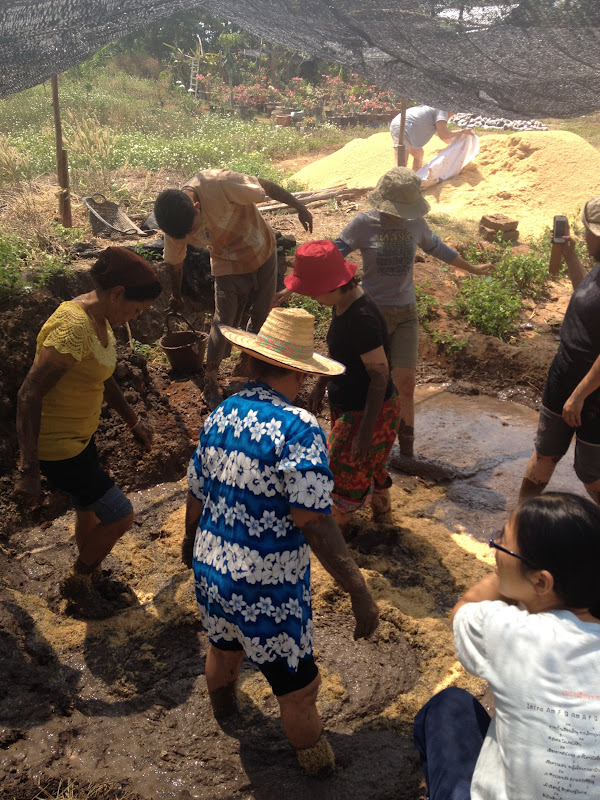
足で粘土質の土と水を混ぜます。徹底的に混ぜてから、籾殻を加えます。プールが二つあって、塗り壁用と日干し煉瓦用です。日干し煉瓦用の籾殻の料は塗り壁用の料より役2倍ぐらいです。
After thoroughly mixing clayey soil and water, add aggregate, in this case, rice hulls.  A plaster mix will have roughly half the amount of rice hulls as an adobe mix.
日干し煉瓦の型枠です。寸法が400mmx200mmx10mmです。
Adobe Frames: The dimensions are 400mmx200mmx10mm
 
出来た日干し煉瓦です。
Finished Adobe
 
日干し煉瓦積み
Laying Adobe
マチェーテで日干し煉瓦を削ってたり、割ったりします。
Shaping and splitting adobe are done with a machete.
バンディン・シッカータイではほとんどの建物が木造や鉄骨、RC構造です。日干し煉瓦は充填として使用されています。
At Bandin Sikkhathai, most of the buildings are framed with wood, steel or concrete with adobe infill.
スターフルーツ
Star fruit
3日の用にカイルがストローベイル建築について講演しました。
On the 3rd, Kyle spoke about straw bale building in Japan.

2012-02-29

善了寺ベイル壁内装仕上げ Zenryoji Update

善了寺の聞思堂ベイル壁の内装を仕上げました。
Finished the interior plaster of the straw bale walls of Zenryoji Temple's Monshido Enshirnment Hall.
数多い方々と相談して、大変助かりました。そして、新田さん、石田さん、高田さん、ご苦労様でした。4月に外装を仕上げましょう!
This is the largest straw bale building or plastering job I've done, and I needed good advice and a great team to get it done.


一箇所がはっかされて、また塗り直さないといけません。
Though one mistake: There was some efflorescence on earthen-lime finish plaster of the the display bench.  From what I gather, it was too cold and done too late in the day without enough time to dry before temperatures dropped in the evening.  The other bench plastered earlier in the day had no problems.  This display will have to be replastered.

善了寺のブログのリンクは下です。
Further details can be found at the link below.
http://zenryouji.blogspot.com/2012/02/blog-post_17.html
http://zenryouji.blogspot.com/2012/02/blog-post_14.html

2012-02-28

福島県にて土蔵 Earthen Storehouses in Fukushima Prefecture

研究のために定期的に福島市か郡山から飯舘村まで車で行っています。道沿いの土蔵や民家をよく鑑賞しています。
On several occasions I've traveled by car from Fukushima City or Koriyama to Itatemura.  Along the way are numerous traditional earthen plastered homes and storehouses.  On my trip to and from Itatemura today, I stopped to take photographs of two.
川俣町付近 Near Kawamatacho

飯野町付近 Near Inomachi.
 奥さんと話して、40年前にお嫁した時にすでに漆喰で仕上げていない土蔵がありました。きっと戦前に建てられました。

 I spoke with the wife of the owner.  She said that the earthen storehouse was there when she married into the family 40 years ago.  I think we can assume that it was built prior to world war II.

2012-02-27

福島県飯舘村までいな家 Madei Home in Itate Village, Fukushima Prefecture


On September 27 traveled to Itate Village to collect data from a model ecological home built in 2009-2010 with a grant from the Japanese Ministry of the Environment.  A detached atelier features a straw bale wall I helped build in February, 2010.  We intended to finish the wall in 2011, but due to the Fukushima nuclear accident, Itate Village is now an evacuation zone.  Although it is located just outside of the 20km mandatory evacuation radius, part of the village is a hotspot for radiation.
2.07microsieverts/hour outside of the atelier (natural background radiation is 0.03-0.08microsieverts/hour)

外壁通気構法のお陰で年間の壁内相対湿度が非常に低いです。
The relative humidity inside the straw bale wall is very, very low year-round due to the ventilated rain screen exterior siding.

2012-02-23

レトロメテロ・ゲストハウス RETROMETRO Guesthouse

2月19日と23日にヒロ君となべさんの現場へ応援し行きました。レテロメテロというゲストハウスです。
February 19 and 23 helped Hiro-kun and Nabe-san with the renovation of RETROMETRO, a guesthouse in Asakusa.
ストローベイルベンチ
Lightweight cement plaster over metal lath creating wave-like dept with a straw bale bench.

土セメント仕上げ Soil-cement finish
Please see the links below for further details and photos. 更なる詳細は下です。
レトロメトロゲストハウス
建設の記録

2012-02-22

横浜市にて旧小岩井家 Koiwai-ke in Yokohama

7月22日にフィル君と北村さんと一緒に横浜市にある旧小岩井家を見学しに行きました。
September 22 visited Koiwai-ke, a Japanese folk home surviving from the late Edo period (1847).
母屋 Main House

立派な梁 Post and Beam Structure

藁縄作り機械 Machine for making straw rope

2012-02-13

原っぱカフェ

2月13日に後輩たちが大分県湯布院にある原っぱカフェを訪ねました。2010年2月に原っぱカフェでのストローベイルワークショップを指導しました。後輩たちによると、ベイル壁がまだいい状態だそうです。左官材料が日本珪藻土株式会社の珪藻土です。
 On February 13, three younger students in Itonaga-sensei's research studio visited Harappa Cafe in Yufuin, Oita Prefecture.  In February of 2010 I lead the construction of Harappa Cafe's straw bale interior.  According to the students, the interior was still in excellent condition, which is a testament to the Keisodo plaster used.