2011-03-25
Straw Bale PhD Thesis ストローベイル博士論文
On March 25 I was awarded a PhD (Bioresource Sciences) 博士(生物資源科学) from Nihon University. My dissertation is available at the link below.
Itonaga-sensei and Kyle
Due to the earthquake, tsunami, and subsequent nuclear crisis, Nihon University, and many other Universities in Tokyo, canceled the main graduation ceremony.
Fujisawa has regular power outages, but instead of canceling the Fujisawa campus graduation ceremony altogether, they abbreviated it to a short 30 minute ceremony and then handed out certificates separately.
2011-03-20
大津磨き講習会 Otsu Polished Earthen-lime Plaster
1) Practice panels were hung. These panels had already had the brown coat (中塗) applied.
2) Plaster two coats of the Haitsuchi (灰土).
The Haitsuchi consists of 1 part quicklime putty to 2 parts earthen plaster.
The quicklime putty is aged for more than several weeks.
The earthen plaster consists of 1 part soil sieved through a 100 mesh and 1.5 parts "Hidashi" rice straw fibers about 10mm long. Hidashi designates a type of rice straw fiber about 10mm long, as opposed to "Mijin" fibers which are less than 3mm with the stem nodes shifted out.
3) Plaster two coats of the Otsu finish coat.The Otsu finish coat consists of 3 parts earthen plaster to 1 part quicklime putty.
The earthen plaster consists of 1 part soil sieved through a 100 mesh, 1 part pigment, and 0.01 part paper fibers. Further details on processing the paper fibers can be found at Mr. Tomizawa's blog.

2011-03-19
2011-03-14
Earthquake and Tsunami Disaster Relief
I'm am member of an NPO in Japan called Ecology ArchiScape (hereafter EAS). EAS works to connect people, nature, art, and the built environment. The president of EAS is my professor, Dr. Koji Itonaga. Fifteen years ago Prof. Itonaga began working with Iitate Village, a rural community in Fukushima Prefecture. Last year EAS and Prof. Itonaga's research studio supported the construction of a model ecological home and sustainability center in Iitate Village. I lead a straw bale building workshop at the facility. Iitate Village is located 30-40 km from Fukushima Dai-ichi Nuclear Power Plant.
To put it simply, Iitate Village is in critical condition. Over 1000 tsunami refugees have taken shelter in elementary schools in Iitate Village, which normally has a population of 6000 people. Food, heating oil, and gasoline are in short supply. Iitate Village is now also a refugee area for those living within 20km of the nuclear power plant. However, atmospheric radiation levels in Iitate Village are above normal and Iitate Village has been declared an indoor evacuation zone (屋内退避), meaning that people are instructed not to go outside. A graph depicting radiation levels in Iitate Village is available here. And much worse, tap water tested at Iitate Village showed more than triple the level of radiation allowed by the government. Japan's Health Ministry is urging Iitate Village residents not to drink the tap water.
Several group evacuations have occurred, carrying hundreds of residents and refugees southwest. Unfortunately, farming is an important occupation in Iitate Village and many people cannot leave their livestock.
That all being said, EAS is raising money to provide emergency assistance to Iitate Village. Please visit the EAS homepage for further information.
To put it simply, Iitate Village is in critical condition. Over 1000 tsunami refugees have taken shelter in elementary schools in Iitate Village, which normally has a population of 6000 people. Food, heating oil, and gasoline are in short supply. Iitate Village is now also a refugee area for those living within 20km of the nuclear power plant. However, atmospheric radiation levels in Iitate Village are above normal and Iitate Village has been declared an indoor evacuation zone (屋内退避), meaning that people are instructed not to go outside. A graph depicting radiation levels in Iitate Village is available here. And much worse, tap water tested at Iitate Village showed more than triple the level of radiation allowed by the government. Japan's Health Ministry is urging Iitate Village residents not to drink the tap water.
Several group evacuations have occurred, carrying hundreds of residents and refugees southwest. Unfortunately, farming is an important occupation in Iitate Village and many people cannot leave their livestock.
That all being said, EAS is raising money to provide emergency assistance to Iitate Village. Please visit the EAS homepage for further information.
2011-03-11
日本ロケットストーブ普及協会 広島県 共生庵 Japan Rocket Stove Association in Hiroshima Prefecture
2011-02-24
ロケットストーブ Rocket Stove 福島県飯舘村 Iitate Village, Fukushima Prefecture
Rocket stoves are fuel efficient, high temperature cooking and heating stoves. One characteristic of rocket stoves is that oxygen is drawn through the fuel, resulting in higher temperature combustion compared to some conventional cooking and wood burning stoves. Another characteristic of rocket stoves is that they are often hand built as opposed to purchased.
Basic Thermal Mass Rocket Stove Section
The following describes the construction of a thermal mass rocket stove in Iitate Village, Fukushima Prefecture.
100 liter (25 gallon) drum can
Central heat riser: Japanese concrete U-pipe surrounded by vermiculite and perlite (insulation) within 100 liter drum can
Vermiculite and perlite insulation
Placing 200 liter (50 gallon) drum over the heat riser
200 liter drum can
Completed rocket stove with thermal battery
The following describes the construction of a thermal mass rocket stove in Iitate Village, Fukushima Prefecture.
2011-02-16
古民家工房 Traditional Japanese Timber Framing
February 16, helped Mr. Takahashi of Kominkakobo (古民家工房) with the assembly of a timber frame home in Chiba Prefecture.


2011-01-18
立場 Great Sea
Last fall helped one day with the renovation of a temple not far from where I live.
Construction was led by Hiro Asano. Hiro and a group of eccentric architects and craftspeople construct beautiful and unique buildings throughout Japan, ranging from Okinawa to Hokkaido.
On January 17, Hiro, Aya, Acchan, Maeno-senpai, Tanaka-kun and I moved about three tons of left over soil from the building site to my research center.
Earthen cement exterior plaster and rammed earth interior walls
2010-11-25
佐野オトリ店 山梨県南巨摩郡南部町 茅葺屋根 Japanese Thatch Roofing
November 25-26 helped Sano-san with the re-thatching of his 300 year old home.
Sano-san is the quinsential Hyakusho (百姓). He grows rice and vegetables for his family, and produces tea and raises Ayu fish for income. In his lifetime, this is the third time he’s thatched his home.
Last spring I helped Sano-san with the thatching of the hira (平), the plane of the roof. This time work was done on the mune (棟), the ridge.
Sano-san is the quinsential Hyakusho (百姓). He grows rice and vegetables for his family, and produces tea and raises Ayu fish for income. In his lifetime, this is the third time he’s thatched his home.
2010-11-21
五箇山 茅葺屋根 Japanese Thatch Roofing
November 21-22 attended a thatching workshop in Gokayama (五箇山), Toyama Prefecture sponsored by the Japan Thatch Roof Culture Association directed by Professor Kunihiro Ando of Tsukuba University.
Gokayama is famous for it’s thatch roofs, and as a result, is a world cultural heritage Center.
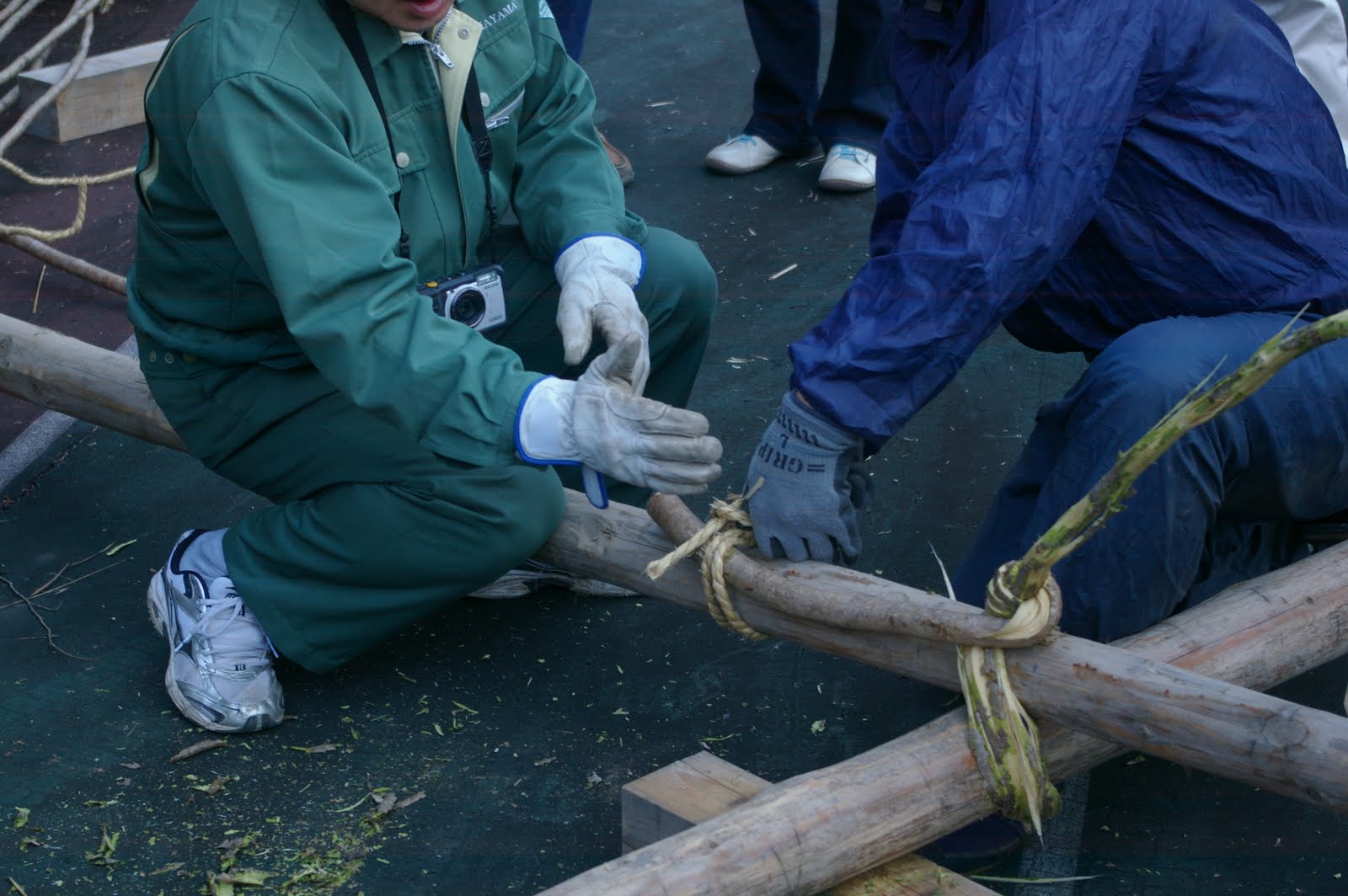
Structure of thatch roof characteristic of Gokayama. In order to secure the ridge thatching, two poles cross under the ridge as opposed to Shirakawago's (白川郷) single pole. Notice the structure is lashed together with straw rope, vines, and small young trees twisted and beaten into lash.
Cedar Bark Used as Siding
2010-11-16
Leyenda Antique Gallery and Store
Last fall helped Hiroaki Yoshimoto with the construction of a straw bale building in Toyama Prefecture.
The building is being constructed with the assistance of the owners Naosuke and Akane Teranishi and will function as an antique store.
Naosuke and Akane import and sell European antiques. The name of the building and store is “Leyenda”, and was named after my favorite classical guitar piece, originally written by Issac Albeniz for piano and transcribed for guitar by Andre Sagovia.
The straw bale walls are plastered on both sides with lime based plasters.
The exterior features ventilated rainscreens to protect the bale walls from rain and snow.
In November, Leyenda was featured in several newspapers.


More photos are details are available at the following websites:October http://www.sakichi-k.jp/2010/10/
November http://www.sakichi-k.jp/2010/11/
Leyenda Blog (at the bottom of the page, click on the arrow to the right to see previous posts)
Subscribe to:
Posts (Atom)