 During the months of May and June, I’ve been working as the primary builder and workshop instructor of the straw bale portions of Café Slow, a café just west of Tokyo and the nucleus of a number of environmental currents in Japan and abroad. http://www.cafeslow.com/
 The café serves fair trade coffee and vegan, organic meals, and sells various organic and fair trade goods. The café needed to move from its previous location and wanted to use straw bales in its new interior. There were a total of 10 workshops in which well over 100 people participated, children and adults alike.
 This is what the site looked like on May 1.
 On June 14 and 15, Café Slow held an opening party.
 At the entrance of the café there is a small straw bale wall inspired by the Okinawan Henpun, a wall built just inside the entrance of homes in Okinawa to keep unwanted energies and spirits from entering the house.

We also plastered the bathrooms with Keisoudo, a commercial earthen lime, cement plaster.
 Café Slow was designed by Oiwa-sensei, the architect I work with most for my research. Beginning in July we’ll be building a straw bale café in Chiba-Prefecture for Saya Takagi, a rather famous actress who’s become a back-to-the-lander. However, unlike Café Slow that uses straw bales mainly as an ornamental interior, the straw bale café in Chiba will be a post and beam structure with straw bale infill.


 On May 15 the three of us went to Kyoto to see the Aoi festival, one of Kyoto’s three famous festivals. In contrast to the Japanese Matsuri of common folk, the Aoi festival was traditionally observed by the aristocracy.
  On May 16 I traveled to northern Kyoto-Prefecture to conduct research while Kudo-san showed Grant around Kansai (the Osaka, Kyoto, Nara region).
  Have been studying traditional Japanese architecture, timber framing, and earthen plasters. Notice that the pillars of this massive structure are not anchored to the ground. Simply the weight of the building holds it in place and allows it to move slightly in the event of an earthquake.
  Traditionally, temples and shrines are roofed with Japanese Cypress bark, while homes, etc. are roofed with thatch, straw, or tile.


 Unfortunately traditional roofing methods and materials are becoming less common. In fact, many thatch roofs are covered with metal.
  Notice the door of this storage building is built of earth plastered on an internal wooden frame.
 Rain-screens to protect gable ends.
  And when not protected.
  Notice the wooden bars preventing a burglar from breaking in through the window are implanted in the thick earthen plaster.
 On May 17, participated in an earthen plastering workshop at the straw bale milk processing plant in Kyoto-Prefecture.
  On May 18 I stayed with the Okunushi family (Satoru, Namiko, Shino-chan, Fumi-chan).
 They're renovating an old Japanese farm house. Wide concrete sink, wood fired bath, etc.
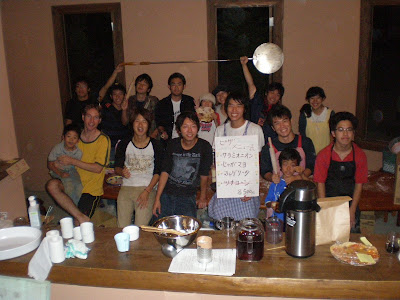
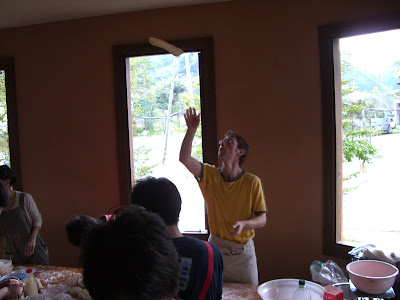
 On May 24 and 25, my research studio baked and sold pizzas at an art event in Fujino, a community in the mountains of Kanagawa.
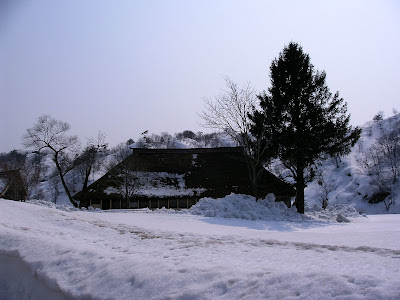
 This is an insulated storage facility, divided roughly in half, and located adjacent to several large greenhouses. Snow is packed in one half the building while perishable goods are stored in the other half. This eliminates the need for summer refrigeration.
 In addition to collecting data, I spent the day with Matsuda, a timber framer who works for a company called Kinokaori (direct translation: scent of trees). He spends 80 percent of his work day in the office, designing, researching, and networking, and 20 percent on site. We visited the site where he harvests his lumber. The trees are prepped before and are felled efficiently with the assistance of a backhoe.
 This is Matsuda’s mentor holding a house plan written in traditional style.
 We visited this old local timber-frame shrine. Note how the post is not anchored to the foundation stone. This allows the post to move slightly in the event of an earthquake. Traditional Japanese timber framing is categorized at 柔構造 (soft structure) in contrast to hard modern building which counters earthquakes through rigidity. Matsuda showed me some of the projects he’s worked on.

 On October 26 I gave a tour of our research center, Center for Natural Environmental Sciences, to a number of Nihon University international students.
  On October 24 I presented at an Ecovillage Conference in Tokyo.




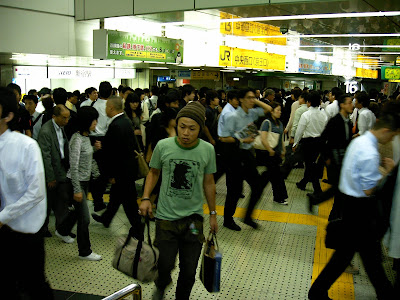 Above is Shinjuku station. Below is Ichigaya station, the station closest to my Japanese language course.

 Traditionally, 荒土壁 (aratsuchikabe), that is walls of bamboo and mud plaster, are built between posts. Junya checks out the plaster mixing station: trough, mud, chopped straw.